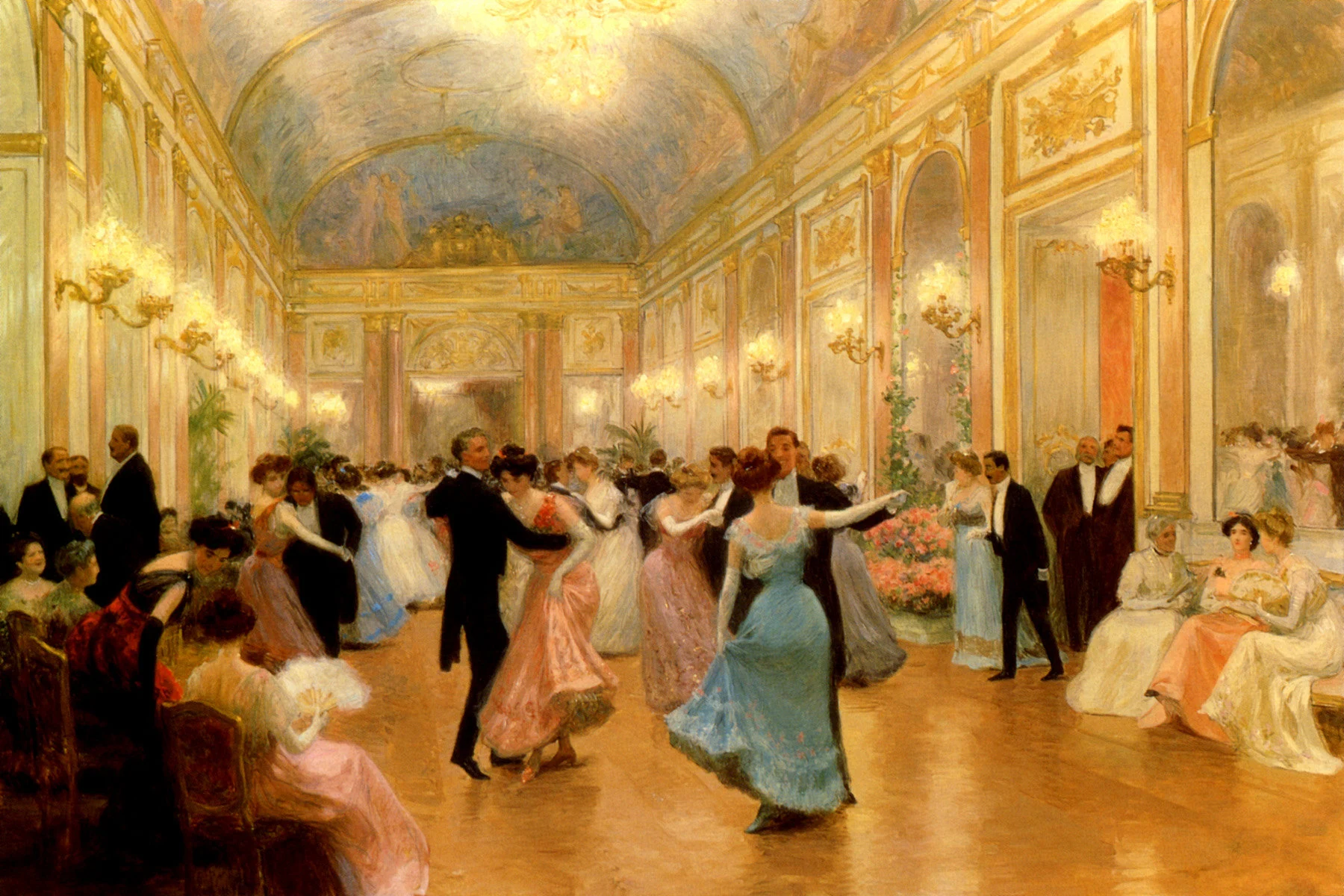
The end of the 19th and the dawn of the 20th Century was a time of transition in social dancing. The well-worn traditions of the Victorian ballroom, which had seemed daring and innovative to previous generations were wearing thin in that modern age of telephones, electric lights, recorded sound, moving pictures and constant change - a new age called for something new.
That something new was Ragtime. This African-American innovation, with its syncopation and contagious beat infused the dance scene with a new energy and sense of fun,.
It was banned from the stodgier ballrooms, and condemned by the sorts of people who think anything new in popular culture is going to destroy the moral fiber of American (or British, French etc) youth. Of course this meant that American (or British, or French etc.) youth insisted on having Ragtime at their dances.
This new music spurred the adoption of a new style of of dancing. The signature couple dance of the early Ragtime era was the Two-Step. The Tw0-Step was danced to 4-4 or 2-4 time music, and was essentially left-together-left and right-together-right (quick-quick-quick-slow-quick-quick-quick). It was basically a modified Polka but it had a very different feel, a different affect.
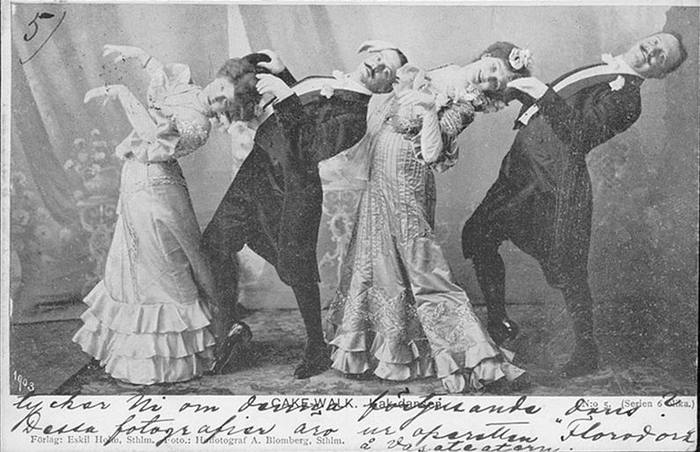
Along with this came another new dance, a group dance (also an African-American invention) called the Cake Walk. The Cake Walk started as a way for the black folks to mock the affected manners of the white folks. The male dancers often wore top hats and carried canes, while the female dancers carried parasols and big hats. The white folks either didn't know or didn't mind that the joke was on them, and the Cake Walk became an international sensation in the later years of the 19th Century and the first years of the 20th.
The dancers would form a column of couples, with either a lead couple or a single leader dancing ahead to show the way, while all paraded around the room, often with a kicking step (the dancing frog in the famous Warner Bros. cartoon is doing a Cake Walk step). They would then form an inward facing circle, and couples would take turns moving to the center and doing their own improvised routine. Originally, the couple judged to have done the best routine would be awarded a cake (hence the name). The name persisted even if baked goods were not on offer.
Even once the Cake Walk faded away in the early 20th Century, its contribution to popular dance continued. The Cake Walk gave dancers permission to be silly and undignified on the dance floor. These liberated dancers went on to dance the Turkey Trot, the Camel Walk, the Grizzly Bear, the Aeroplane Glide, the Mississippi Dippy Dip and any number of dances their parents deeply disapproved of.
The Cake Walk could be done to a lively Ragtime tune (many dances were written specifically as Cake Walks) or to the marches of John Philip Sousa, which were also an international sensation, combining with Ragtime to overwhelm an unsuspecting world with American popular culture,
The other foundation dance of the time was the Waltz, an amazingly resilient dance that managed to persist through generations of music fads and changing fashions. The Waltz of the turn of the 20th Century appears to have been evolving to a simpler form, but it was still essentially the Waltz.
A typical dance card of the era might include nothing but Two-Steps and Waltzes, or it could include a Cake Walk or even a Quadrille (essentially a square dance). Set dances had been the foundation of balls in the mid 19th Century, and had been becoming less prevalent as the century drew on, but they were still to be found on programs that were a bit on the conservative side or prized a bit of variety.
When I speak of the "ballroom" I am not speaking of a singular phenomenon. Dancing was universal, up and down the social scale from the brightly lit, sumptuously decorated ballrooms where the social elite of the Gilded Age, with their impeccable manners, danced in their dress suits and elaborate ballgowns; to the neighborhood dancehalls where working class boys and girls came after a hard days work to find relaxation, and perhaps love in the big city.
Here are a few videos to illustrate the dances I discussed.
The Cake Walk
The Two-Step
A traditional Waltz.