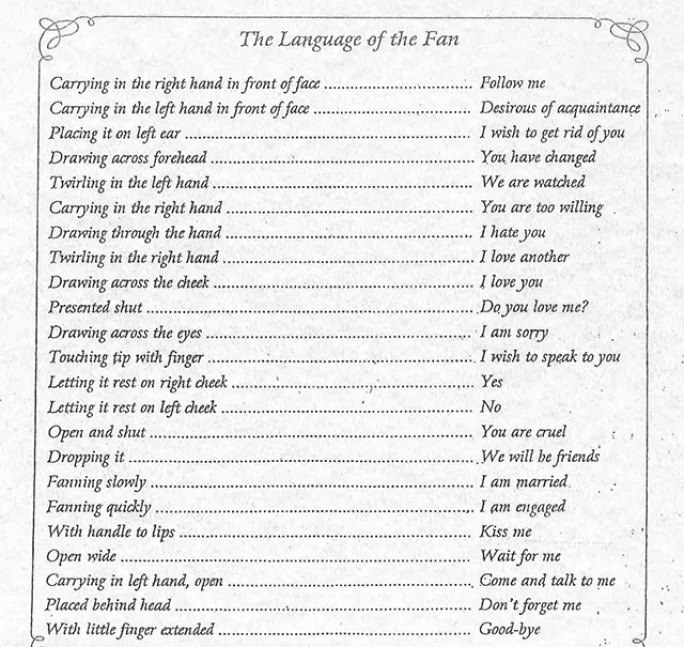
It never seems to fail: when hobbyists, or docents or re-enactor groups decide to do something on "Victorian Etiquette", they haul out "The Language of the Fan".
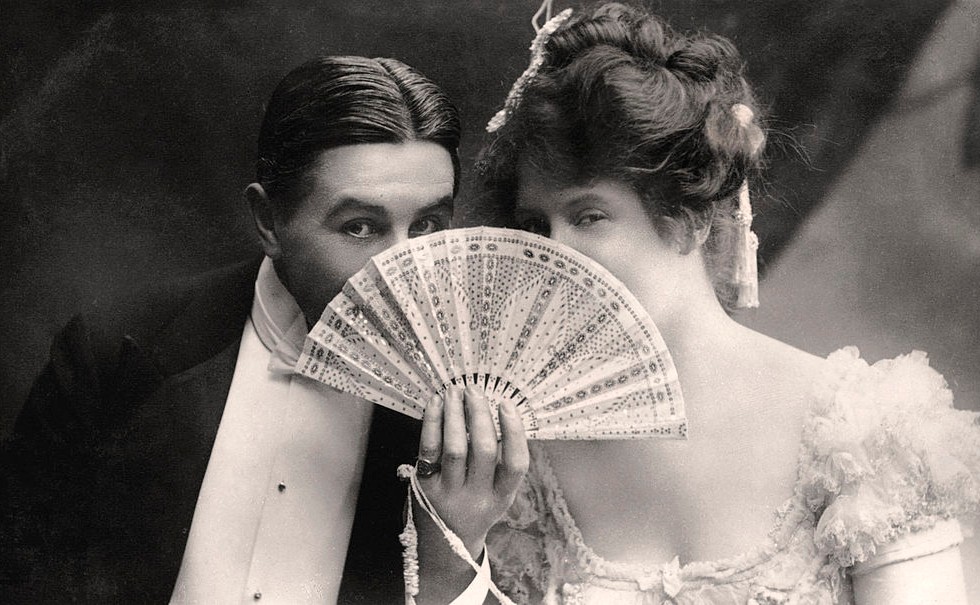
The premise of this is that there was a universally understood form of fan-based semaphore which was used to convey secret love messages between young ladies and young gentlemen.
Certainly, the fan can be a very eloquent communication tool. It can be snapped to indicate irritation, or peeked over flirtatiously, or used for emphasis in ways that one needs no code book to decipher. What I have never found however, in any 19th Century etiquette book or work of literature, is a reference to the formalized code that is so often repeated today, ever being put to use.
Further, there is the utter illogic of it.
For a code to work, both the sender and recipient have to know it. So, not only would Victorian girls need to memorize this stuff, but so would the boys. Everything I have ever discovered about Victorian males suggests that they had very little patience for the frillier bits of Victorian social ritual. When ladies were turning down the corners of visiting cards to indicate any number of things, gentlemen were just leaving their cards and being done with it. From the frequent complaints on the subject, it was hard enough to get men to come in from the veranda to dance with the ladies. Getting them to memorize a confusing code would be asking one too many things of a young man.
And, if you look at the actual code (see below), nearly everything a woman could do with a fan is assigned some meaning. How would anyone know if she was warning off an importuning suitor, or the ballroom was just a bit stuffy? It's almost impossible to NOT send multiple coded messages in the space of a few minutes. A proper code needs a prompt, a key that says "Message follows". There is no such clue included in this clueless code.
Finally, the American Civil War demonstrated on numerous occasions that if you want to keep a secret, don't use semaphore to transmit it. IF this code existed and Victorian girls memorized it, and tried to use it to convey secret love messages to a boy who probably hadn't bothered to learn it, the chances would be quite good, nay inevitable that the disapproving matron across the room HAD memorized it and would read it far better than any clueless man.
Boys and girls have had ways to understand (and misunderstand) each other since time began, and such a clumsy contrivance would have only muddled things that are better conveyed with a glance, a smile (or a frown) a touch or quiet word.
I don't know the original source of this persistent myth. I have been told, but have not personally verified, that it may have appeared as a "trial balloon" or even satire in a ladies magazine--or perhaps as a gimmick to sell fans.
The best that can be said about it though, is that while it MAY have been mentioned in a period source, I have found no evidence that would suggest that it was ever put into practice.
I would strongly suggest that those who want to present information on Victorian etiquette spend their energies on more pervasive and important (but perhaps less quaint) things like introductions, calling cards, visiting, proper dress etc. - things that actually mattered to the Victorians.